Notre Histoire
History of
Grand Coteau
From 1776 to Today
How It All Began
Buzzard Prairie
The first known land grant by the colonial Louisiana government is issued in what is then called Buzzard Prairie. The ridge, once the western bank of the ancient Mississippi River, rises above the surrounding flatlands.
Stagecoach Town
Buzzard Prairie becomes a thriving stop between Washington and St. Martinville. Two bakeries, a cobbler, a millinery, a blacksmith shop, a post office, six bars, and nine brothels. This town had range.
The Academy Arrives
Mrs. Charles Smith donates land and funds to bring two nuns from Missouri. The Religious of the Sacred Heart found the Academy of the Sacred Heart — the oldest continually operating Sacred Heart school in the world. Five boarding students on day one.
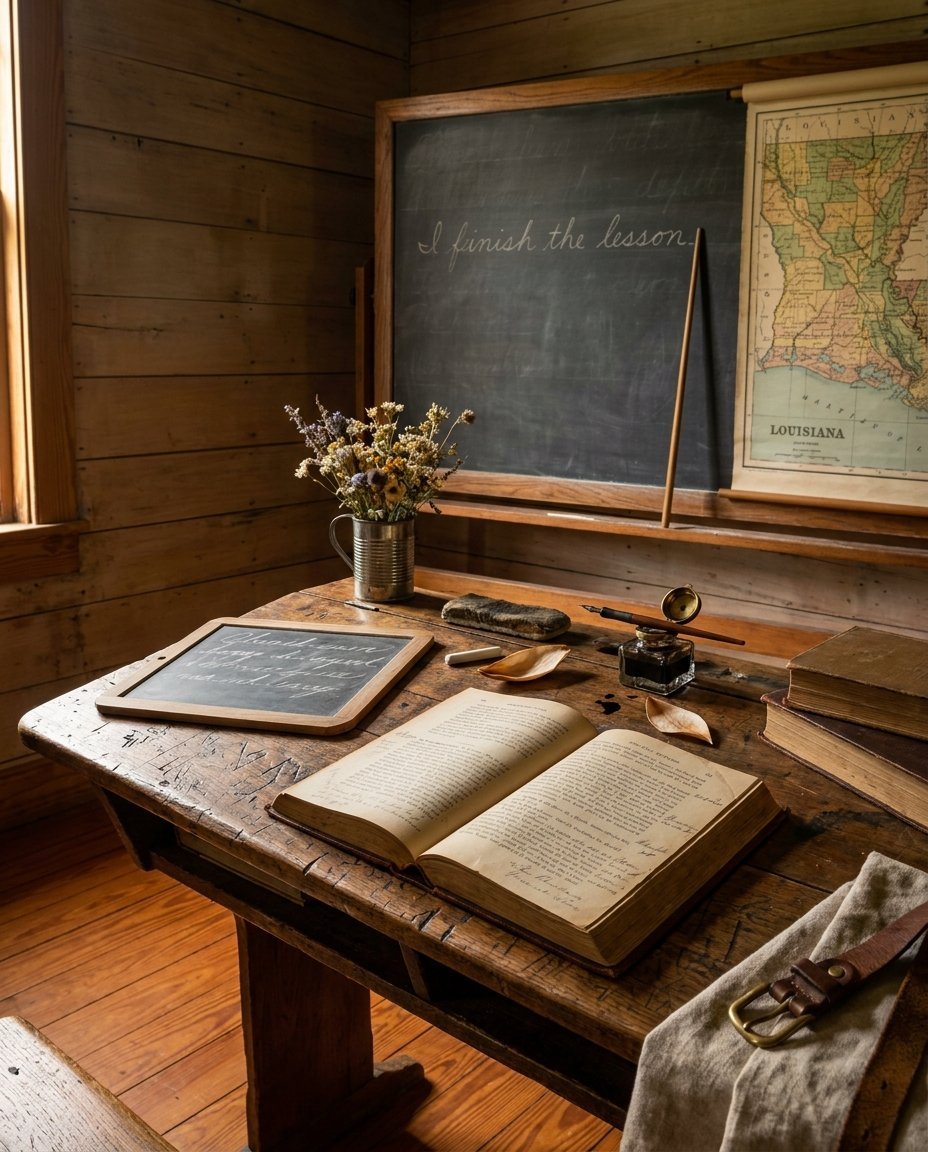
The Jesuits Come
The RSCJ offer the Jesuits 100 acres of free land plus 200,000 bricks they had been saving for a chapel. St. Charles College is built. The settlement is called St. Charles Town before being renamed Grand Coteau — French for "great hill."
The Miracle
Novice Mary Wilson falls gravely ill. An apparition of Blessed John Berchmans appears and cures her. The Vatican investigates and recognizes the miracle — the only one in the United States recognized at its exact location. John Berchmans is later canonized.
Battle of Grand Coteau
Confederate forces under General Richard Taylor launch a surprise attack on Union troops on November 3. Thousands of Union soldiers are encamped around the Academy. General Nathaniel Banks — whose daughter attended a Sacred Heart school in New York — protects the nuns and students. The school does not close.
A Growing Community
African Americans, free people of color, Acadians, Creoles, French, Irish, and German immigrants build Grand Coteau's 19th-century boom. Victorian architecture rises. The town becomes a place where Creoles of Color can legally marry in the church — a distinction that matters.
National Register of Historic Places
The Grand Coteau Historic District is listed — one of the few primarily rural districts in the nation. Over 70 architecturally significant structures recognized. Creole, French, Acadian, Anglo-American, and Victorian styles all represented.
Notre Histoire Noire
Black History
of Grand Coteau
This is the most layered, most underreported chapter of Grand Coteau's story. It spans from 1874 straight through to the present day — and it is inseparable from the town's Catholic identity.
1874
Edward Campbell's School
A year before the official Catholic colored school opened, a Black Protestant man named Edward Campbell was already teaching 50 boys on the Jesuit grounds. This fact is buried in history. It belongs at the top.
1875
Colored School of the Sacred Heart
The RSCJ — the same order running the Academy for white girls — opens a school to educate young Black girls in the former convent building. By 1888, the Archbishop of New Orleans, the RSCJ Superior General, and the Jesuits fund a new building and expand to boys.
1930s–1947
St. Peter Claver School
The school is renamed St. Peter Claver in the 1930s. Father Cornelius Thensted, S.J. builds a full compound — high school, convent for the Sisters of the Holy Family, gym. Jesuits join the faculty. Students come from four surrounding parishes.
1948
First Graduating Class
Seven graduates. Two became teachers. One an orderly. One a mechanic. One an electrical mechanic. One a business owner. One a secretary in California. From a small town in Jim Crow Louisiana, that is extraordinary.
1940s–1960s
Father Cornelius Thensted, S.J.
For over two decades, Father Thensted was the civil rights Jesuit — confessor, protector, church-builder, and pastor to the Black community. He stood up to white residents who tried to limit his work. He raised funds from Mother Katharine Drexel. He wore himself out in service.
1982–Present
The Thensted Center
Named for Father Thensted by Sister Margaret "Mike" Hoffman, RSCJ. Built on the former St. Peter Claver grounds. "Not hand out — hand up." Still serving Grand Coteau, Sunset, Bellevue, and Arnaudville today. 268 Church Street. (337) 308-4025.
The Legacy
A School That Ran for Nearly 100 Years
St. Peter Claver School produced teachers, clergy, mayors, and builders of this community. Its graduates became the first Black female mayor of Grand Coteau — and of all of St. Landry Parish. The school closed. The buildings remained. The legacy lives in every person who walked through those doors.
Today, the former St. Peter Claver complex — church, school buildings, gym — is still in use. The Thensted Center runs from those grounds. The story continues.
Share Your Story